PPTP, L2TP/IPsec and SSTP: The Legacy VPN Protocols in 2026
PPTP, L2TP/IPsec and SSTP are the VPN protocols built into operating systems before WireGuard and modern apps existed. The quick verdict: never use PPTP, because its usual login method has been publicly breakable since 2012. Treat L2TP/IPsec as a legacy fallback and move off it when you can. SSTP is still supported but tied to Windows. For anything new, use WireGuard or IKEv2.
This guide covers what each one is, why it is fading, the dated record of its retirement, and what to replace it with. The standards are cited by RFC number, and the vendor steps come from Microsoft's and Apple's own pages.
Quick verdict
| Protocol | Ports and transport | Encryption | Status in 2026 | Replace with |
|---|---|---|---|---|
| PPTP | TCP 1723 + GRE (IP protocol 47) | Weak; usual MS-CHAP v2 login breakable | Removed by Apple (2016); still in Windows client | WireGuard or IKEv2 |
| L2TP/IPsec | UDP 500 + 4500, ESP (IP protocol 50); L2TP UDP 1701 inside | From IPsec; L2TP alone has none | Still built into Windows, macOS, ChromeOS | IKEv2/IPsec or WireGuard |
| SSTP | HTTPS (TCP 443) | TLS | Supported on Windows; recommended by Microsoft | Keep, or move to IKEv2 |
| IKEv2/IPsec (for reference) | UDP 500 + 4500 | IPsec | IETF standard, RFC 7296 | - |
If you only need the action list: switch off PPTP today, schedule L2TP for replacement, and leave SSTP alone unless you are moving away from Windows. The rest of this page explains why.
PPTP: fast, broken, and why
PPTP, the Point-to-Point Tunneling Protocol, was developed in the 1990s by a group of companies that included Microsoft and Ascend. It was written up as RFC 2637 in July 1999. That RFC is 'Informational', so PPTP documents a vendor protocol and was never an IETF standard. PPTP opens a control connection on TCP port 1723 and carries data in an enhanced form of GRE, which is IP protocol 47, not a port.
PPTP's weakness is its login. Most PPTP setups authenticate with MS-CHAP version 2. On 20 August 2012 Microsoft published Security Advisory 2743314 after detailed exploit code for MS-CHAP v2's weaknesses went public. Microsoft said that anyone who captures the handshake, for example on open Wi-Fi or through a man-in-the-middle attack, could recover the user's credentials. It treated this as a protocol weakness rather than a bug, so there was no patch. Its suggested fixes were to wrap the login in PEAP or to 'use L2TP, IKEv2, or SSTP VPN tunnels' instead.
In plain terms: PPTP was fast because it did little, and what it did is no longer trustworthy. Apple's support article on removing PPTP says it does not recommend PPTP 'for secure, private communication'. If a router, NAS or old office server still offers PPTP, turn it off.
L2TP/IPsec: secure enough, awkward
L2TP, the Layer 2 Tunneling Protocol, was standardised in RFC 2661 in August 1999 and uses UDP port 1701. On its own it encrypts nothing. Security comes from running it inside IPsec, which RFC 3193 (November 2001) describes. That is why you see the combined name L2TP/IPsec.
The combination is reasonably secure with modern IPsec settings, but awkward in practice. It needs UDP 500 and 4500 for the IPsec key exchange and NAT traversal, plus ESP, IP protocol 50, when there is no NAT. Those fixed ports make it easy for a hotel or office firewall to block. The tunnel is wrapped twice, which costs speed. Many consumer setups use a pre-shared key, and when that key is published on a website or shared by every user, anyone who has it can impersonate the server.
L2TP/IPsec is still built into Windows, macOS (as 'L2TP over IPSec') and ChromeOS. That is its remaining strength: you can connect to an old office gateway without installing anything. For any new setup, IKEv2/IPsec does the same job with fewer layers and better handling of network changes. Our IKEv2 guide explains the differences.
SSTP: the Windows TLS tunnel
SSTP, the Secure Socket Tunneling Protocol, is Microsoft's. Its specification, first published in 2007, describes carrying network frames over an HTTPS connection. Because it uses HTTPS, it travels on TCP port 443 and is hard to block without blocking the web. That makes it the most firewall-friendly of the three.
SSTP's limits are reach and transport. It is native to Windows, but Apple's built-in VPN types for Macs are L2TP over IPSec, Cisco IPSec and IKEv2, so SSTP is not among them. It runs over TCP, so it inherits the TCP-over-TCP slowdown on bad connections, as our TCP vs UDP guide explains. It is not broken, and, according to trade-press reports of its October 2024 post, Microsoft recommends it alongside IKEv2 as the way forward on Windows Server.
L2TP/IPsec vs IKEv2: the practical differences
People often weigh these two because both come built into most operating systems and both rely on IPsec. IKEv2 wins on nearly every practical point. It's a single protocol for key exchange instead of L2TP stacked on IPsec, so there is one layer less to configure and less overhead per packet. It has been a full IETF standard since RFC 7296 in October 2014.
IKEv2 also handles movement better. Its MOBIKE extension, RFC 4555 from June 2006, lets a tunnel keep running when a phone moves from Wi-Fi to mobile data. L2TP/IPsec usually has to reconnect. Both use the same UDP ports 500 and 4500, so neither has an advantage on a firewall that blocks IPsec. There, SSTP or a TCP 443 option is the fallback.
The one place L2TP/IPsec still wins is compatibility with very old gateways and clients that predate IKEv2 support. If that is your situation, the device is due for replacement anyway.
How to check which protocol you're using
If you connect through your operating system's built-in VPN, the protocol is in the connection settings. On Windows 11, go to Settings, then Network & internet, then VPN, where your connections are listed with their settings. The VPN type was chosen when the connection was added. If it says 'Automatic', Windows tries each built-in type in turn, from the most secure to the least. On a Mac, open System Settings and choose VPN. Each configuration shows its type: L2TP over IPSec, Cisco IPSec or IKEv2.
If you use a VPN provider's app, the protocol menu is in the app's settings, usually under 'Protocol' or 'Connection'. Commercial apps generally offer WireGuard-based, OpenVPN, IKEv2 or their own protocols, not PPTP. If a provider's app still offers PPTP as an option in 2026, take that as a reason to look elsewhere.
Routers and NAS boxes list their VPN server types in the admin panel, often under 'VPN Server'. Check there for a PPTP server that was switched on years ago and forgotten. It's the most common way PPTP survives in a home.
The retirement timeline
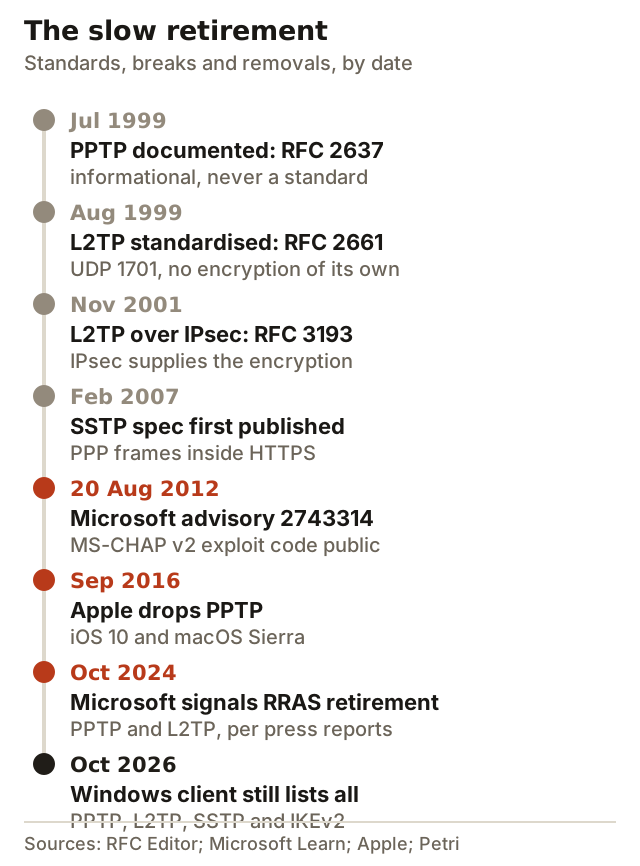
Three dates matter most. In August 2012, Microsoft's advisory confirmed that PPTP's usual login could be cracked from a captured handshake. In September 2016, Apple removed PPTP: iOS 10 shipped on 13 September and macOS Sierra on 20 September, and both strip PPTP entries from VPN profiles during the upgrade. In October 2024, Microsoft's networking team published a blog post on PPTP and L2TP deprecation. Petri reported on 15 October 2024 that it means future Windows Server VPN servers (RRAS) won't accept incoming PPTP or L2TP connections, and that Microsoft points to SSTP and IKEv2 instead.
We could not read Microsoft's post directly, so treat its scope as reported. PPTP and L2TP don't appear on Microsoft Learn's official lists of deprecated Windows or Windows Server features as of October 2026. Microsoft's own page on Windows' built-in VPN client, updated on 8 October 2026, still lists IKEv2, L2TP, PPTP and SSTP. So on Windows these protocols are being phased out on the server side first, with no removal date for clients.
Google never built PPTP into ChromeOS. Its built-in VPN types are IKEv2, L2TP/IPsec, OpenVPN and, on some Chromebooks, WireGuard. PPTP is available there only through Android apps.
Migrating: what replaces each
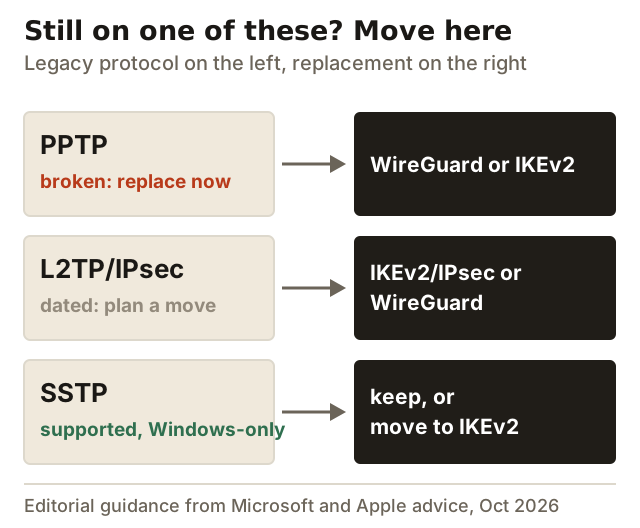
The right replacement depends on what you're connecting to.
- A consumer VPN service: use its app with WireGuard or the provider's own protocol. No major provider needs PPTP or L2TP. See WireGuard vs OpenVPN for which to choose.
- An office VPN on Windows Server: move PPTP users to IKEv2 or SSTP now, and plan for L2TP users to follow. Both are built into Windows clients, so staff need no new software.
- A mixed fleet of Windows, Mac and iPhone: IKEv2/IPsec is the common ground. It is built into all three, and Apple listed IKEv2/IPsec among its suggested alternatives when it removed PPTP.
- A home router or NAS: if it offers WireGuard or OpenVPN, use those and switch PPTP off. If it offers only PPTP, the device is too old to trust as a VPN endpoint.
Before you switch off the old protocol, test the replacement from a hotel or mobile network as well as from home. The most common surprise is a firewall that allows TCP 443 but drops UDP 500 and 4500. IKEv2 fails there, while SSTP or OpenVPN over TCP 443 gets through.
If you're replacing an old router PPTP setup with a commercial service, NordVPN is one option among the WireGuard-based providers we cover. Our protocol guide ranks the alternatives by use.
Edge cases
- 'Free L2TP servers' lists: public pages that post a shared L2TP username, password and pre-shared key give everyone the same keys. Anyone on that list can impersonate the server. Avoid them.
- Compliance audits: PPTP will fail most security audits on its own. If an auditor finds it, the fix is to remove it rather than wrap it.
- Mac users told to 'use SSTP': macOS has no built-in SSTP. Ask your IT team for IKEv2 instead of hunting for a third-party SSTP client.
- Speed comparisons: old claims that PPTP is 'the fastest protocol' compare it with heavy setups from the 2000s. Modern WireGuard is fast and secure, so speed is no reason to keep PPTP.
PPTP, L2TP and SSTP: common questions
Is PPTP still safe to use?
Is L2TP a VPN protocol with encryption?
What port does a PPTP VPN server use?
What is an SSTP VPN?
Is Microsoft removing PPTP and L2TP from Windows?
Still deciding? Compare the options in our guide to the best VPN protocols and when to use each, or read the head-to-head on WireGuard vs OpenVPN.