Most Secure VPN Protocol (2026): Five Tests, One Answer, and the Post-Quantum Layer
The most secure VPN protocol for most people in 2026 is WireGuard, or a modern provider protocol built the same lean way, running in an app that adds post-quantum key exchange. OpenVPN with its default AES-256-GCM cipher is just as strong cryptographically and remains the better choice on networks that block VPNs, while IKEv2/IPsec is secure when the provider configures it well. PPTP is broken and should never be used, and L2TP offers no encryption of its own.
Read-out: pick WireGuard, or a modern provider protocol such as NordLynx or Lightway, with post-quantum protection switched on. Use OpenVPN on TCP 443 where WireGuard is blocked. Skip PPTP entirely.
"Most secure" pages usually rank VPN providers, not protocols, and mention post-quantum encryption in passing. Here we judge the protocols themselves against five tests you can check, using each project's own documentation and the providers' support pages, read on 18 October 2026. If you want the broader chooser, start with our VPN protocols comparison.
The five tests that decide "most secure"
Security is not one number, so we ask five separate questions. First, are the ciphers modern and authenticated, so tampering is detected as well as reading prevented? Second, how much code sits in the path, since every line is somewhere a bug can hide? Third, how easy is it to set the protocol up weakly? Fourth, how often are keys replaced, so a stolen key exposes as little as possible? Fifth, and new in importance this year, is there a path to post-quantum key exchange that protects today's recordings against tomorrow's computers?
| Test | WireGuard | OpenVPN 2.6 | IKEv2/IPsec |
|---|---|---|---|
| Data cipher | ChaCha20-Poly1305, fixed | Negotiated; default list AES-256-GCM, AES-128-GCM, ChaCha20-Poly1305 | Negotiated from many optional algorithms |
| Code in the path | Under 4,000 lines (Linux, per whitepaper) | Large, long-reviewed codebase plus a TLS library | Large framework built into operating systems |
| Room for weak setup | Almost none: one fixed suite | Some: options set by the provider | Most: many optional algorithms |
| Key replacement | New session keys every 120 seconds | Set by configuration | Set by configuration |
| Post-quantum path | Optional pre-shared key; providers add their own layers | Depends on the TLS library and provider | RFC 9370 adds extra key exchanges |
Why WireGuard comes out on top
WireGuard wins on the tests where the others can go wrong. Its cryptography is fixed: ChaCha20-Poly1305 for data, Curve25519 for key agreement and BLAKE2s for hashing, with no negotiation step that could be pushed onto a weaker option. According to the WireGuard whitepaper the Linux implementation is under 4,000 lines, few enough for a single reviewer to read end to end, and session keys are replaced every 120 seconds. Our deeper look at whether WireGuard is secure covers its one privacy wrinkle, how providers handle the static internal addresses it assigns.
Provider protocols follow the same lean approach. NordVPN's NordLynx is built on WireGuard, ExpressVPN's Lightway is its own modern protocol, and these are where providers have put their post-quantum work, as the next sections show. We compare them in NordLynx, Lightway and proprietary protocols.
OpenVPN: equally strong, more to configure
OpenVPN isn't weaker cryptographically. The OpenVPN 2.6 manual sets the default list of data ciphers to AES-256-GCM, AES-128-GCM and ChaCha20-Poly1305, all authenticated ciphers, and the server picks the first one both sides support. On devices with AES hardware acceleration, AES-256-GCM is fast and strong; our AES vs ChaCha20 explainer covers the trade-off.
Where OpenVPN loses ground is surface area. It relies on a full TLS library for its handshake and offers many options, so the security you get depends more on how the provider has configured it. In exchange it can also use TCP port 443, which ordinary web traffic shares, and that is why it remains the fallback on restrictive networks. If a filter is your problem, our guide to obfuscated VPN protocols goes further.
IKEv2/IPsec: secure when set up well
IKEv2 is an Internet Standard, RFC 7296, and with current algorithms nobody has shown a practical attack on a well-configured connection. Its weakness for this ranking is flexibility: IPsec supports many optional algorithms and modes, so a careless configuration can be weaker than the protocol allows. Reputable providers ship strong settings, and the protocol's MOBIKE extension (RFC 4555) keeps phones connected across network changes, a strength we cover in our IKEv2 for consumers guide. Its fixed UDP ports 500 and 4500 make it easy for networks to block, which is an availability problem rather than a security flaw.
The post-quantum layer: what changed in 2026
Quantum computers don't threaten the bulk ciphers above in a practical way; the worry is key agreement. Someone who records encrypted traffic today could, in principle, recover the keys later with a large enough quantum computer, an attack often called "harvest now, decrypt later". The defence is to add a post-quantum key exchange alongside the classical one, so the session key stays safe if either holds.
NIST published ML-KEM (FIPS 203), the post-quantum standard ExpressVPN and Mullvad both name, on 13 August 2024. Each protocol family has a route to it. WireGuard's protocol page notes that its optional pre-shared key, mixed into the handshake, can add post-quantum resistance, and providers build their own exchanges on top. For IKEv2, RFC 9370 defines multiple key exchanges so post-quantum algorithms can be combined with classical ones. OpenVPN's handshake runs over TLS, so any post-quantum exchange depends on the TLS library and the provider's configuration.
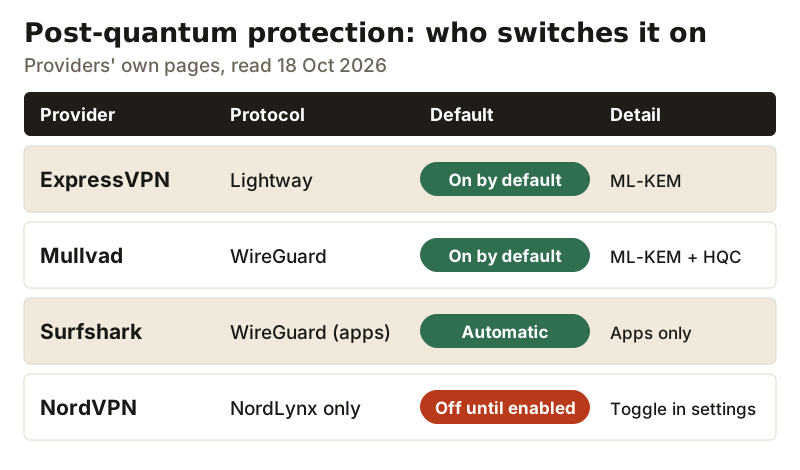
Providers differ most on the default. ExpressVPN states that post-quantum protection is on by default in Lightway, which now uses ML-KEM. Mullvad's quantum-resistant tunnels are on by default in its current apps and combine ML-KEM with HQC; Mullvad dropped OpenVPN in January 2026 and now runs WireGuard alone. Surfshark says it has added post-quantum protection on top of WireGuard in its apps, though not for manual configurations. NordVPN's support centre says its post-quantum encryption works with NordLynx only and is switched on in the app's settings; it is disabled when you use a dedicated IP, another protocol, obfuscated servers or Meshnet. So for a NordVPN user, the most secure setting is one you have to choose.
The ranking, from most to least secure
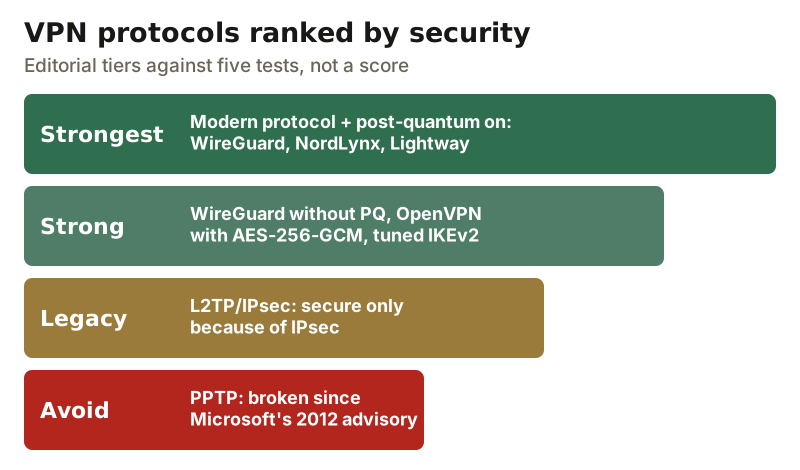
The bottom of the list is settled. L2TP doesn't encrypt anything itself; its security comes entirely from IPsec, and it adds nothing a modern protocol needs. PPTP's authentication has been broken in public since Microsoft's Security Advisory 2743314 of 20 August 2012, and Apple dropped PPTP support in 2016, with iOS 10 and macOS Sierra. Our legacy protocols page explains what replaces each.
What protocol choice can't fix
A strong protocol guards only the leg between you and the VPN server; beyond that machine it does nothing. The provider still sees what leaves its server, so its logging and its record of independent audits count for as much as the cipher; our page on whether VPN protocols are safe covers those limits. If you want a provider that turns post-quantum protection on without a setting to find, ExpressVPN and Surfshark apply it automatically on Lightway and WireGuard respectively; NordVPN offers it as a NordLynx toggle. Those three are affiliate links and pay us a commission on sign-ups. Mullvad, which has no affiliate programme, turns it on by default.
Edge cases
- Manual configurations: Surfshark says its post-quantum layer isn't available on manual setups, so a router running its WireGuard config gets classical key exchange only.
- Dedicated IPs and obfuscation: on NordVPN, both switch post-quantum encryption off, so you trade one protection for another.
- Restrictive networks: the most secure protocol that connects beats the most secure one that's blocked. Fall back to OpenVPN over TCP 443 rather than to PPTP.
- Router and business gear: IPsec appliances may not support RFC 9370 yet; check your firmware notes before assuming post-quantum protection.
Most secure VPN protocol: quick answers
What is the most secure VPN protocol?
Is OpenVPN more secure than WireGuard?
Is IKEv2 secure?
What is post-quantum encryption in a VPN?
Which VPN protocols should I never use?
Still deciding? Compare the options in our guide to the best VPN protocols and when to use each, or read the head-to-head on WireGuard vs OpenVPN.